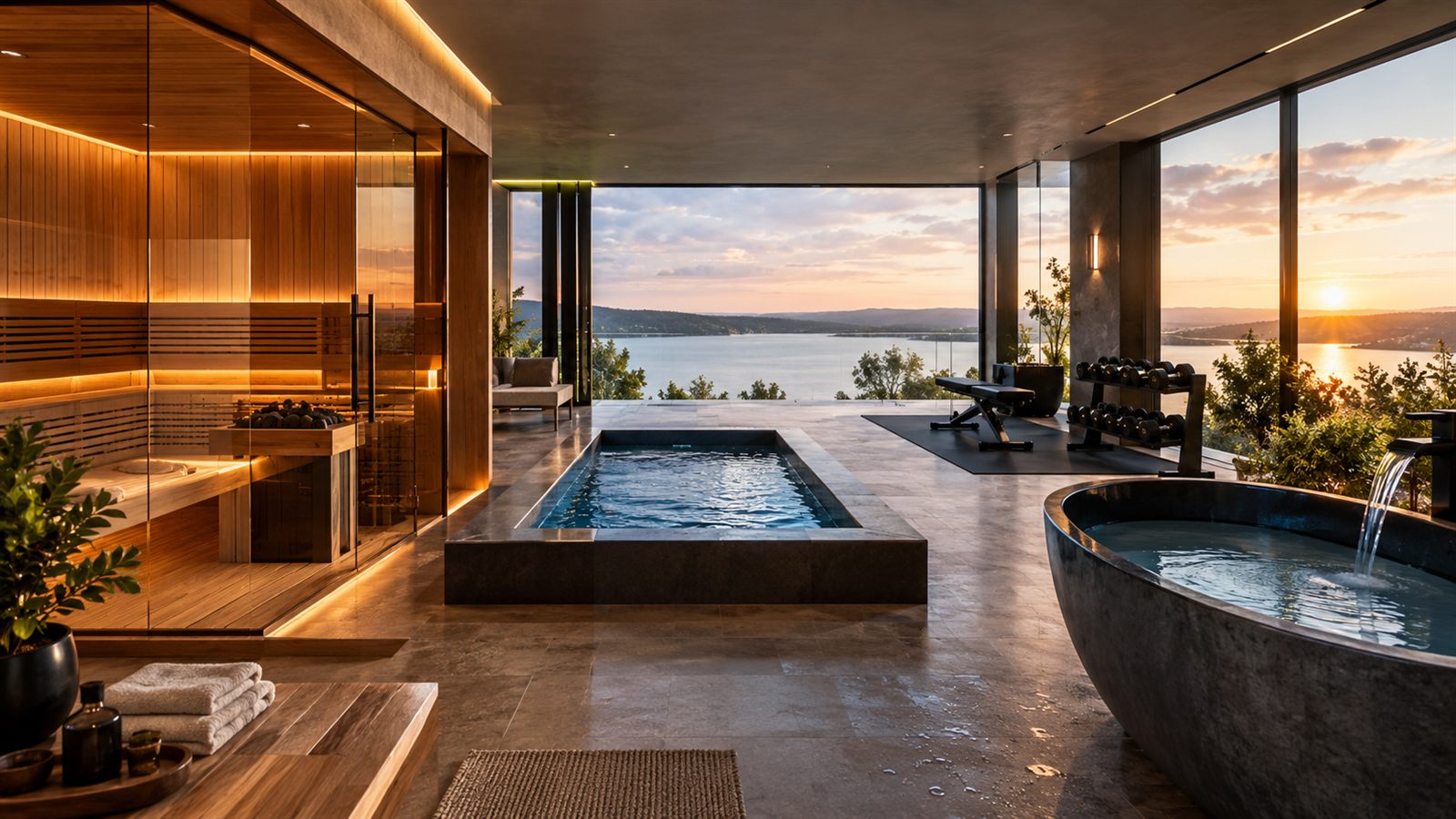
A custom wellness space affects a New Jersey or New York luxury home's value through two separate, unrelated mechanisms, and most online advice conflates them. The first is buyer demand: Sotheby's International Realty's 2026 Mid-Year Luxury Outlook found wellness-oriented luxury homes command a 10 to 25% higher price than comparable homes without those features, and real NJ/NY listings already market saunas and cold plunge rooms as headline amenities. The second is formal appraisal, which works differently. A licensed appraiser applying the cost approach can assign a custom build "zero or minimal contributory value" if it's oversized or mismatched for the neighborhood, a concept appraisers call superadequacy. In practice, this means a wellness space almost always helps a home sell for more, but only a well-scaled, professionally integrated build reliably shows up as added value on a formal appraisal.
It's Already Showing Up in NJ & NY's Top Listings
This isn't a future trend. It's already how agents are marketing seven- and eight-figure homes across the region right now. Rye, NY real estate advisor Fiona Dogan, who works the Westchester luxury market daily, writes that "almost every luxury home now has a gym, but some take it further with spa-like additions, think steam rooms, cold plunge pools, or yoga studios," and points to a recent Rye listing that marketed its lower level (complete with a wine cellar, game room, and golf simulator) as its own selling point, not an afterthought to the main house. That's the pattern worth noticing: in the current NJ/NY luxury market, a well-built recovery or wellness space is being listed and photographed the same way a chef's kitchen or a home theater would be: as a primary reason to tour the house, not a bonus room buried in the listing description.
Two Different Ways "Value" Actually Gets Measured
Here's where most articles on this topic stop short, and where the real answer gets more useful. "Does this increase my home's value?" is actually two different questions with two different answers, because real estate professionals measure value in two distinct ways.
| Approach | What It Asks | When It Applies |
|---|---|---|
| Sales comparison | What will a buyer actually pay? | Active market listings, most home sales |
| Cost approach | What is the improvement worth as a physical asset? | New construction, thin comparables, refinance and estate appraisals |
The sales comparison approach asks what a buyer will actually pay, and this is where the wellness premium is real and documented. Sotheby's International Realty's own 2026 research found wellness-oriented homes commanding a 10 to 25% premium over comparable properties, with buyer interest in the category more than doubling over five years. This is demand-side value: it shows up when your home is on the market and buyers are comparing it to others in your price bracket.
The cost approach is what a bank's appraiser uses, especially for new construction or when comparable sales are thin, and it works completely differently. It doesn't ask what buyers want; it asks what the improvement is worth as a physical asset, starting from replacement cost and then subtracting for anything the market won't fully credit. This is the approach that actually determines the number on a refinance or an estate appraisal, and it's the one nobody selling saunas ever explains.
The Appraisal Risk Nobody Talks About: Superadequacy
This is the part worth slowing down for, because it's the difference between a wellness space that protects your investment and one that doesn't. New Jersey Real Estate Appraisal Group (a state-certified appraisal firm with more than 26 years of combined experience across all 21 New Jersey counties) explains the concept appraisers call superadequacy plainly: when an improvement is oversized or mismatched for what the market in that specific location expects, "the market will not pay for the excess," and the appraiser is required to deduct for it as a form of functional obsolescence, even though the improvement itself is high-quality and expensive to build.
The build doesn't change. The neighborhood does.
Applied to a wellness space, the principle is straightforward: a beautifully built custom sauna and cold plunge room in a $1.2M colonial in a neighborhood of similar $1.1 to 1.3M homes can face the same superadequacy discount that an oversized swimming pool or an over-scaled addition would, regardless of how well it's built, if it pushes the home meaningfully outside what buyers in that specific micro-market expect to pay for. The same build in a $4M Bergen County or Westchester estate, where wellness infrastructure is now a standard expectation at that price tier, faces no such discount.
This is exactly why "does a sauna add value" doesn't have one universal answer: it depends on whether the space is scaled to the home's actual market tier, not just how much it costs to build.
What Actually Protects the Investment
The practical implication is that the goal isn't just building a wellness space. It's building one that reads as a natural extension of a home at its specific price point, not an outsized addition bolted onto a house that doesn't call for it. This is the same design discipline Cielo applies whether the project is a Southampton estate winterizing a summer property or a Bergen County basement being reimagined as a private recovery wing: the space is scaled and finished to match the house it's going into, using materials and construction quality (insulated glass, precision aluminum, moisture and ventilation systems designed for the specific site) consistent with the rest of the home, not a standalone box that reads as separate from it.
Put simply: the appraisal risk isn't in building a wellness space. It's in building one that doesn't match the house around it.
For Architects and Developers: Making the Case to a Client
If you're specifying a wellness space for a client project, the superadequacy concept above is also the answer to the question you're most likely to get pushback on: "will this actually add value, or just cost money?" The honest answer, and the one that holds up under scrutiny, is that it depends on whether the space is scaled to the property's market tier, which is precisely the kind of judgment call an experienced designer brings to the table rather than a generic equipment supplier. Cielo works directly with architects and developers to size and integrate a custom wellness build around the home's actual market position from the start, rather than proposing a standard package and hoping it fits.
Sized to the house,
not sold as a standalone box
Cielo doesn't sell a sauna as a standalone product. Cielo designs a wellness space as part of the house it's going into, sized and detailed to match the home it serves. That's the difference between an amenity that shows up as value on a real appraisal and one that just shows up as square footage.
See Completed Projects
Frequently Asked Questions
Not usually as its own line item. It's typically factored into the overall improvement value under either the sales comparison or cost approach, and its treatment depends on how well it matches the home's size and market tier.
There's no universal guarantee, but Sotheby's International Realty's 2026 research found wellness-oriented luxury homes commanding a 10 to 25% price premium, which suggests a well-scaled build is more likely to help than hurt at resale. The bigger risk is an oversized build that doesn't match the neighborhood, not the wellness space itself.
It's the appraisal term for an improvement that's oversized or mismatched for what a specific market expects, meaning the appraiser deducts for the excess as a form of functional obsolescence regardless of the improvement's build quality or cost.
The appraisal principles (cost approach, sales comparison, superadequacy) are national standards under USPAP, not state-specific. What differs by market is the price tier at which a given town's buyers expect to see wellness infrastructure, which is why local scaling matters more than the state line.
Neither is inherently better. The deciding factor is which one fits the specific property naturally (a finished basement or spare room for indoor, existing pool or patio infrastructure for outdoor) rather than which one adds more value in the abstract.
This is general information about real estate valuation, not appraisal, legal, or financial advice. Consult a licensed appraiser or real estate professional for guidance specific to your property.
Cielo designs custom sauna and cold plunge spaces for luxury homeowners and works directly with architects, interior designers, and developers across New Jersey and the New York metro area.